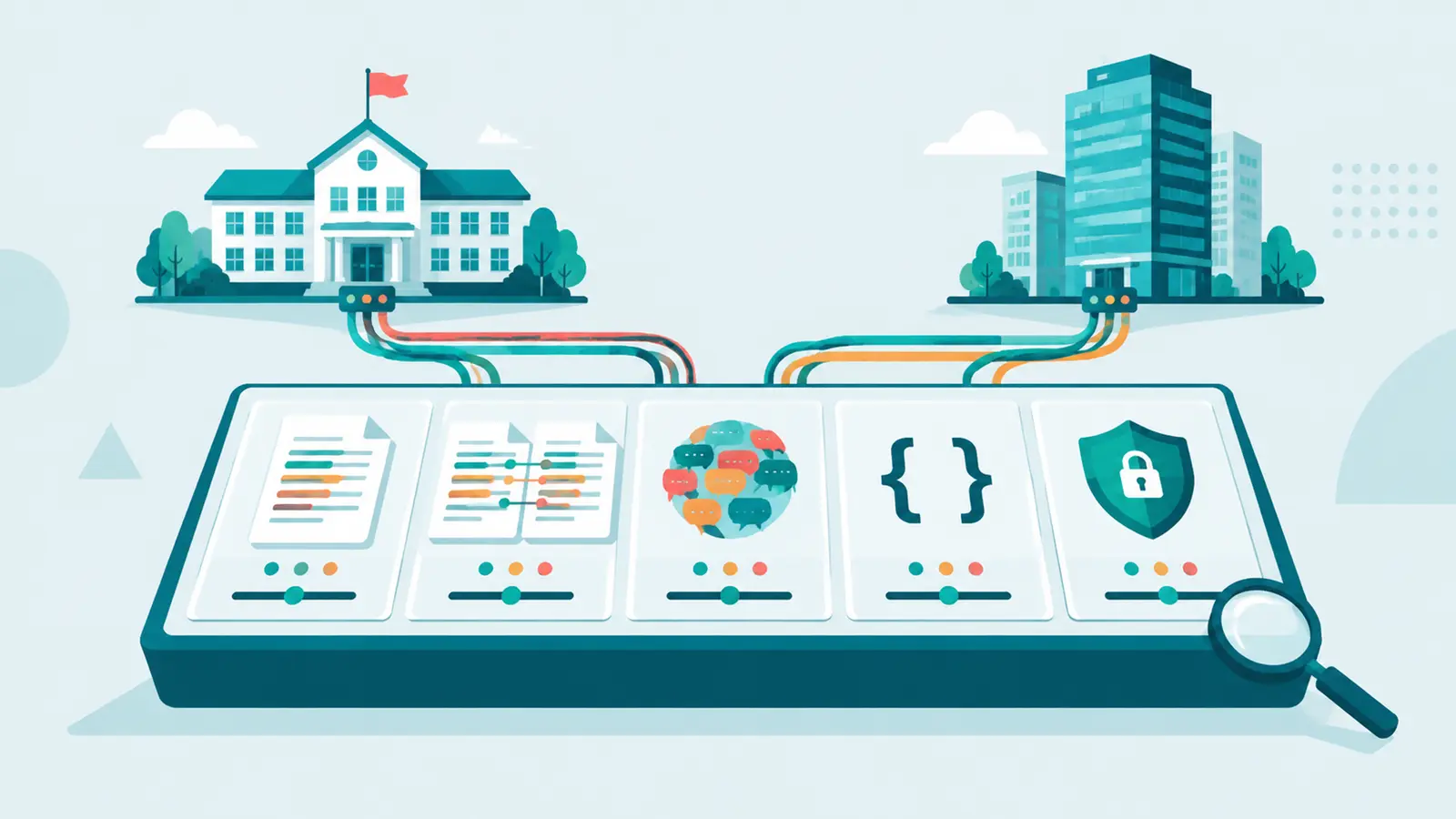
Copyleaks is an AI detection and plagiarism detection company that serves schools, businesses and individual users. Its main strengths, based on what it publicly describes, are breadth: AI and plagiarism checks in one platform, support for many languages, integrations with learning management systems, an API, and tools for source code and for companies governing their own AI use. Like every detector, its AI results are probabilities, not proof.
ZeroTell publishes this blog and makes a competing AI detector and plagiarism checker. We've described Copyleaks using only information it publishes about its own products, without test scores of our own, and we've tried to be fair about what it does well. Features and plans change, so check Copyleaks' site for current details.
What Copyleaks is
Copyleaks started in plagiarism detection and added AI content detection as generative AI spread. It now positions itself as a platform for checking the originality and authenticity of text, with products for education, enterprises and individual writers.
Its audience is broader than many detectors. A teacher, a publisher, a legal team and a software company might all use different parts of it.
Main features
Based on Copyleaks' public product descriptions, its main offerings include the following. Availability depends on the plan.
| Feature | What it does | Who it helps |
|---|---|---|
| AI detector | Estimates whether text was written by AI and highlights passages | Teachers, editors, businesses |
| Plagiarism checker | Compares text against online and other sources for matches | Students, teachers, publishers |
| Multilingual support | Checks text in many languages | International schools and teams |
| LMS integrations | Connects to learning platforms such as Canvas, Moodle and Blackboard | Schools and universities |
| API | Lets developers add checks to their own systems | Companies and platforms |
| Source code checks | Looks for copied or AI-generated code | Programming courses, software teams |
| Generative AI governance | Tools for organizations monitoring how staff use AI and protecting sensitive data | Enterprises with AI policies |
The governance tools stand out because they're unusual. Most detectors only check finished text. Copyleaks also markets products for companies that want to monitor generative AI use and keep sensitive information out of AI tools.
How the workflow fits different users
For teachers and schools
The main appeal for education is integration. If your school's learning platform connects to Copyleaks, submissions can be checked inside the existing workflow rather than copied into a separate website. Combined AI and plagiarism checking means one report covers both questions.
As with any detector, the report should start a review, not end one. Our guide to what AI detectors colleges use explains how institutions typically use these tools.
For businesses and publishers
Content teams can use Copyleaks to screen submissions for originality and AI use, and its API lets platforms build checks into their own systems. The governance tools target a different need: companies that want visibility into how employees use AI and protection against sharing confidential data.
For individual writers and students
Individuals can sign up and check their own work. For a student, that can be a way to catch missing citations before submission. Keep in mind that your school may use a different tool, and different detectors often disagree on the same text.
What Copyleaks does well
- Breadth of checks. AI detection and plagiarism detection in one platform, plus code checking.
- Language coverage. It advertises support for many languages, which matters for international institutions and multilingual teams.
- Integrations. LMS connections and an API make it practical inside existing workflows.
- Enterprise focus. Governance and compliance features suit larger organizations with formal AI policies.
- Institutional options. Schools and companies can arrange custom plans rather than individual subscriptions.
Limits to keep in mind
These limits apply to AI detection generally, Copyleaks included:
- False positives happen. Human writing can be flagged, especially short, formulaic or second-language text.
- Edited and mixed text is harder. Writing that combines human drafting with AI help often produces uncertain results.
- Detectors disagree. A Copyleaks result may not match Turnitin, GPTZero or other tools on the same text.
- Vendor accuracy claims are the vendor's. Like most detector companies, Copyleaks publishes accuracy figures from its own testing. Results on your writing may differ. See how accurate AI detectors are.
- Plagiarism coverage varies. What any checker compares against depends on its sources and agreements. Read the documentation for what's included.
- Complexity. A broad platform can be more than an individual needs.
Warning
Privacy questions to ask
Before uploading student work or confidential documents to any checking service, read its privacy policy and data terms. Useful questions: Is submitted text stored? For how long? Is it added to a database that future checks compare against? Can you delete it? Copyleaks publicly describes compliance certifications and data protection practices; schools and companies should confirm the details with their own IT or legal teams.
How it compares with alternatives
All descriptions are based on public information.
- Turnitin: an institutional plagiarism platform with an AI writing indicator, licensed by many universities. Students usually can't access it directly.
- GPTZero: an AI detector focused on educators, with writing-process features.
- Originality.ai: aimed at publishers and content teams.
- Winston AI: an AI detector with plagiarism checking for education and publishing. See our Winston AI review.
- ZeroTell (ours): a sentence-level AI detector, a public-web plagiarism checker that links every matching source, and an AI humanizer and writing tools, built for individual writers rather than institutions.
For a wider overview, see how to choose the best AI detector.
Plagiarism CheckerFind matching sourcesWho Copyleaks suits best
A good fit if you:
- run a school or department that wants AI and plagiarism checks inside its learning platform,
- work with text in many languages,
- need an API or enterprise features such as AI governance,
- teach programming and want code checks.
Maybe not the best fit if you:
- are an individual writer who mainly wants to improve your own draft after a check,
- need the exact tool your university uses, which may be Turnitin,
- want a simple tool without institutional features.
Using any detector responsibly
- Publish a clear AI policy before relying on detection.
- Read the highlighted passages rather than reacting to a number.
- Ask for process evidence such as drafts and version history.
- Talk with the writer before taking any formal step.
- Students: keep your drafts and disclose AI use where your course requires it.
Key takeaways
- Copyleaks offers AI detection and plagiarism detection for education, enterprises and individuals.
- Its strengths are breadth: many languages, LMS integrations, an API, code checking and AI governance tools.
- Its AI results are probabilities; false positives and disagreements between tools happen.
- Treat vendor accuracy figures as vendor claims and test on your own writing.
- ZeroTell publishes this review and makes competing tools; check Copyleaks' site for current features and pricing.